

Local Government Reorganisation is a data challenge before it is a systems challenge
Local Government Reorganisation is often discussed in terms of structures, governance, service models and finance. But for the new unitary authorities being created, one of the most important day-one dependencies is much more practical: a single, authoritative address and street gazetteer.
GeoPlace describes "place" as the anchor for LGR and highlights the importance of Street and Address Custodians in reducing risk during reorganisation. It has also noted that new unitary authorities will be responsible for a single Address Gazetteer and a single Street Gazetteer. Source: GeoPlace
That matters because the Local Land and Property Gazetteer and Local Street Gazetteer are not isolated technical datasets. They underpin planning, waste, environmental health, licensing, electoral services, revenues and benefits, customer contact, highways, emergency response and many other services.
If the gazetteer is fragmented, every connected service inherits that fragmentation. If it is unified, accurate and available from the first day of the new authority, it becomes a foundation for continuity and transformation.
Key takeaways
- Treat LLPG and LSG as day-one operational dependencies.
- Merge once, then distribute controlled outputs to legacy systems.
- Plan early with custodians, system owners and data consumers.
- Use LGR as a chance to simplify address and street data foundations.
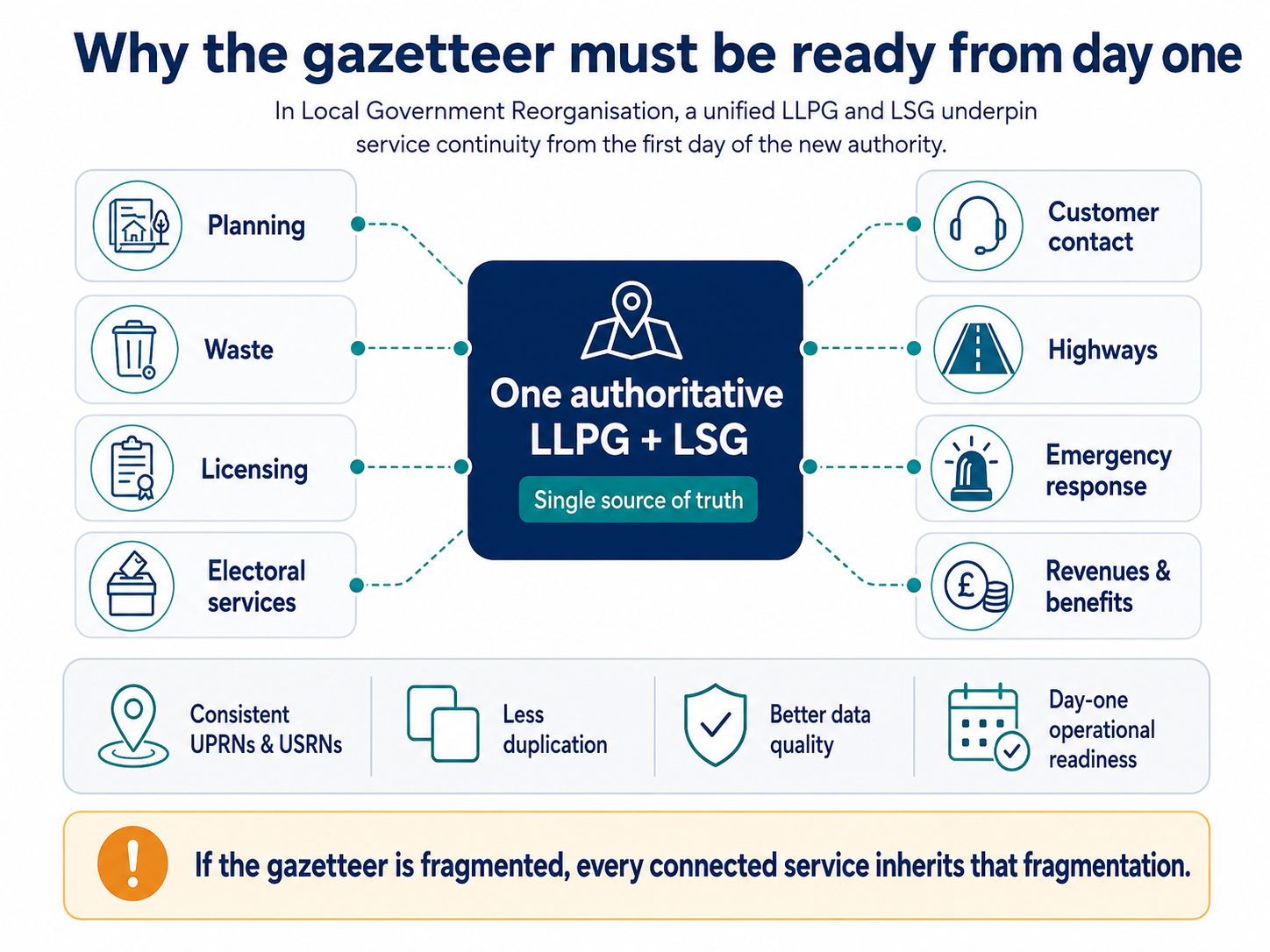
Why a single authoritative LLPG and LSG matters for service continuity from day one.
The gazetteer should not be a technical afterthought
The Local Digital LGR Digital and Cyber Playbook focuses on being ready for day one, collaboration, baselining and reducing digital, data and technology risk during transition. Source: MHCLG Digital
That same principle applies directly to LLPG and LSG management.
A new authority can tolerate many things during transition: phased application replacement, temporary integrations, legacy workflows and parallel operating models. What it cannot tolerate is uncertainty over the authoritative address and street data that every service depends on.
The risk is not simply that a GeoPlace export becomes more difficult. The risk is that different services continue to use different versions of the truth. That leads to duplicated records, inconsistent UPRN and USRN usage, unreliable reporting, avoidable manual work and uncertainty for staff who need to keep services running.
For LGR, the right question is not:
"How do we merge the gazetteers eventually?"
It is:
"How do we operate one authoritative gazetteer from day one, while allowing legacy systems to continue safely until they are replaced?"
That distinction is critical.
Merge once, distribute many ways
StatMap's eVO GMS has been designed for exactly this type of challenge.
A common mistake during reorganisation is to keep predecessor authority gazetteers separate and attempt to reconcile them later through bespoke scripts, manual processes or special export routines. This can appear lower risk at the start, but it often creates cost and complexity later.
The new authority still has to answer fundamental questions:
- Which gazetteer is authoritative?
- Where are new UPRNs and USRNs created?
- Which team owns change intelligence?
- How are duplicate or conflicting records resolved?
- How do downstream systems receive consistent updates?
- How does the authority prove data quality and governance?
With eVO GMS, councils can consolidate multiple LLPGs and LSGs into a single managed environment while still supporting phased operational change.
This is important because not every line-of-business system will be replaced on vesting day. Some systems may need to continue operating on former district or county boundaries for months, or even years, while the new authority rationalises contracts and service models.
eVO GMS supports this transitional reality. A council can operate a unified gazetteer centrally, while still producing full uploads or change-only updates split by legacy areas where required. That allows existing systems to continue consuming the data they need, without forcing the authority to maintain separate gazetteers behind the scenes.
In simple terms: one authoritative gazetteer, many controlled outputs.
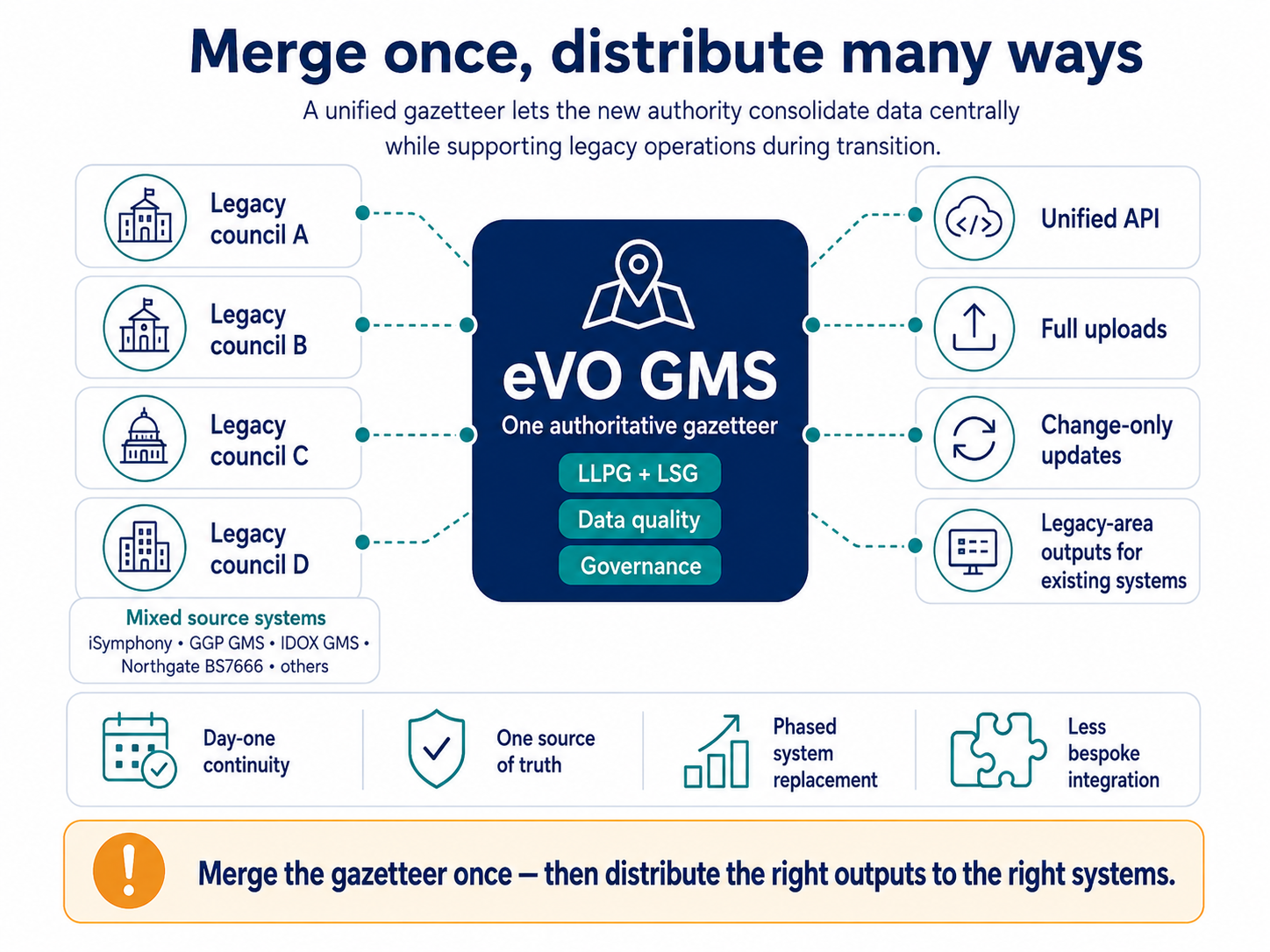
Merge the gazetteer once, then distribute the right outputs to the right systems.
A proven web-based GMS, not a late cloud conversion
Many councils now want web-based systems for resilience, flexible working and easier access across merged teams. But in LGR, being web-based is not enough. The system also needs to be proven, scalable and operationally mature.
eVO GMS has been live as a web-based Gazetteer Management System since 2019. It was not created as a recent response to LGR. It has already supported real councils, real custodians and real operational workloads over several years.
That maturity matters.
During LGR, gazetteer teams may be spread across multiple offices, legacy authorities and management structures. Staff may be working through uncertainty while roles, responsibilities and future operating models are still being agreed. A browser-based GMS helps remove unnecessary barriers: there is no need to install desktop software locally, depend on specialist client applications or limit access to a small number of licensed machines.
StatMap has also expanded eVO GMS performance so that very large gazetteers - including environments with around one million addresses - can be operated effectively through a standard web browser.
For a new unitary authority, that means the gazetteer can be managed at enterprise scale without returning to old desktop deployment models.
Enterprise licensing for real LGR teams
Local Government Reorganisation does not create a neat, single-custodian world overnight.
For a period of time, the new authority may have multiple experienced custodians, multiple legacy processes, multiple service leads and multiple teams that all need access to the same data. Some staff will be focused on business-as-usual updates. Others will be working on data quality, integration, migration, validation, service redesign or supplier transition.
A restrictive per-seat licensing model can become a practical obstacle at exactly the wrong time.
StatMap can provide enterprise licensing for eVO GMS, enabling the new authority to involve the people it needs without turning access into a procurement or licensing problem. This is particularly valuable during the transition period, when councils need to make use of existing knowledge before the final structure is confirmed.
Good LGR delivery depends on governance, but it also depends on access. The right people need to see, manage, validate and use the gazetteer.
Experience across mixed legacy systems
Every LGR programme is different. Some predecessor councils will already share systems. Others will be using a mixture of suppliers, data structures, local conventions and historic processes.
StatMap has direct experience migrating from the main GMS and BS7666 systems currently found across the market, including iSymphony, GGP GMS, Idox GMS, Northgate BS7666 and others.
That experience matters because LGR migrations are rarely clean one-to-one replacements. A new authority may need to merge data from several vendors, reconcile different local practices, preserve UPRN and USRN integrity, support GeoPlace requirements and keep downstream systems operating throughout the transition.
eVO GMS provides a unified platform and API layer that helps councils move from mixed legacy systems towards a single authoritative source of truth. This allows line-of-business systems to integrate with the new gazetteer consistently, rather than each service building its own workaround.
Lessons from previous reorganisations
StatMap has supported councils through previous LGR and unitary transition work, including Cumberland Council, North Yorkshire Council and West Northamptonshire Council.
The experience of North Yorkshire is particularly instructive. Where predecessor gazetteers are kept separate and then reconciled through bespoke processes, the authority can find itself carrying unnecessary complexity into the new organisation. What looks like a temporary compromise can quickly become an expensive operational dependency.
Moving to eVO GMS allowed the authority to operate with a clearer, unified gazetteer model and a more sustainable long-term approach.
The lesson is simple: do not postpone the merge.
Other systems, integrations and operating models can be rationalised over time. But the gazetteer is a day-one dependency. If the new authority starts life with fragmented address and street data, the cost of fixing that fragmentation is pushed into every connected service.
What councils should be doing now
Councils preparing for LGR should begin gazetteer planning early. GeoPlace's current LGR resources encourage early involvement from custodians, preparation of address and street data, and early engagement with GMS suppliers. Source: GeoPlace
Key questions to ask now include:
- Which LLPGs and LSGs need to be merged?
- Which systems consume gazetteer data today?
- Which services will still need legacy-area outputs after vesting day?
- How will UPRN and USRN integrity be protected?
- Who will own change intelligence during transition?
- How many custodians and service users will need access?
- Can the chosen GMS support full uploads, change-only updates and split outputs?
- Can the system scale to the new authority's full address and street workload?
- Does the supplier have experience migrating from all relevant legacy systems?
- Is there a clear API strategy for future integration?
The earlier these questions are answered, the lower the risk for vesting day.
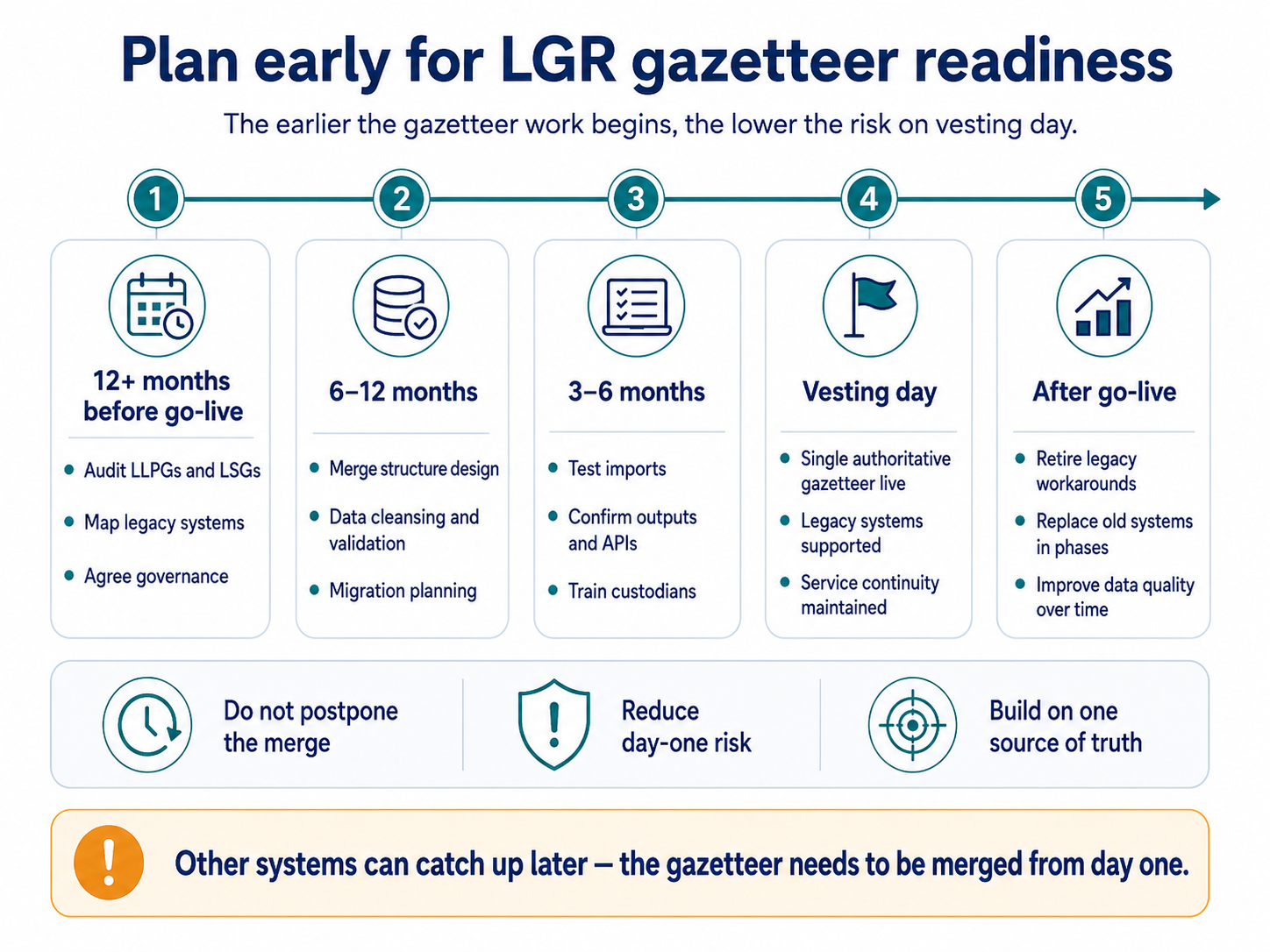
Plan early for gazetteer readiness before vesting day.
eVO GMS: built for unified gazetteer management
eVO GMS is StatMap's web-based Gazetteer Management System for full LLPG and LSG lifecycle management.
It supports:
- unified LLPG and LSG management;
- consolidation of multiple predecessor gazetteers;
- migration from mixed legacy GMS suppliers;
- full and change-only outputs;
- split outputs for legacy systems during transition;
- enterprise access for multiple custodians and teams;
- browser-based operation without desktop client software;
- large-scale gazetteer management, including very large address datasets;
- API-based integration with line-of-business systems;
- long-term data quality, governance and validation.
eVO GMS is the best-selling GMS since 2019 in the UK local government market. For councils preparing for LGR, it provides something more important than software features alone: practical experience of how gazetteers behave during real organisational change.
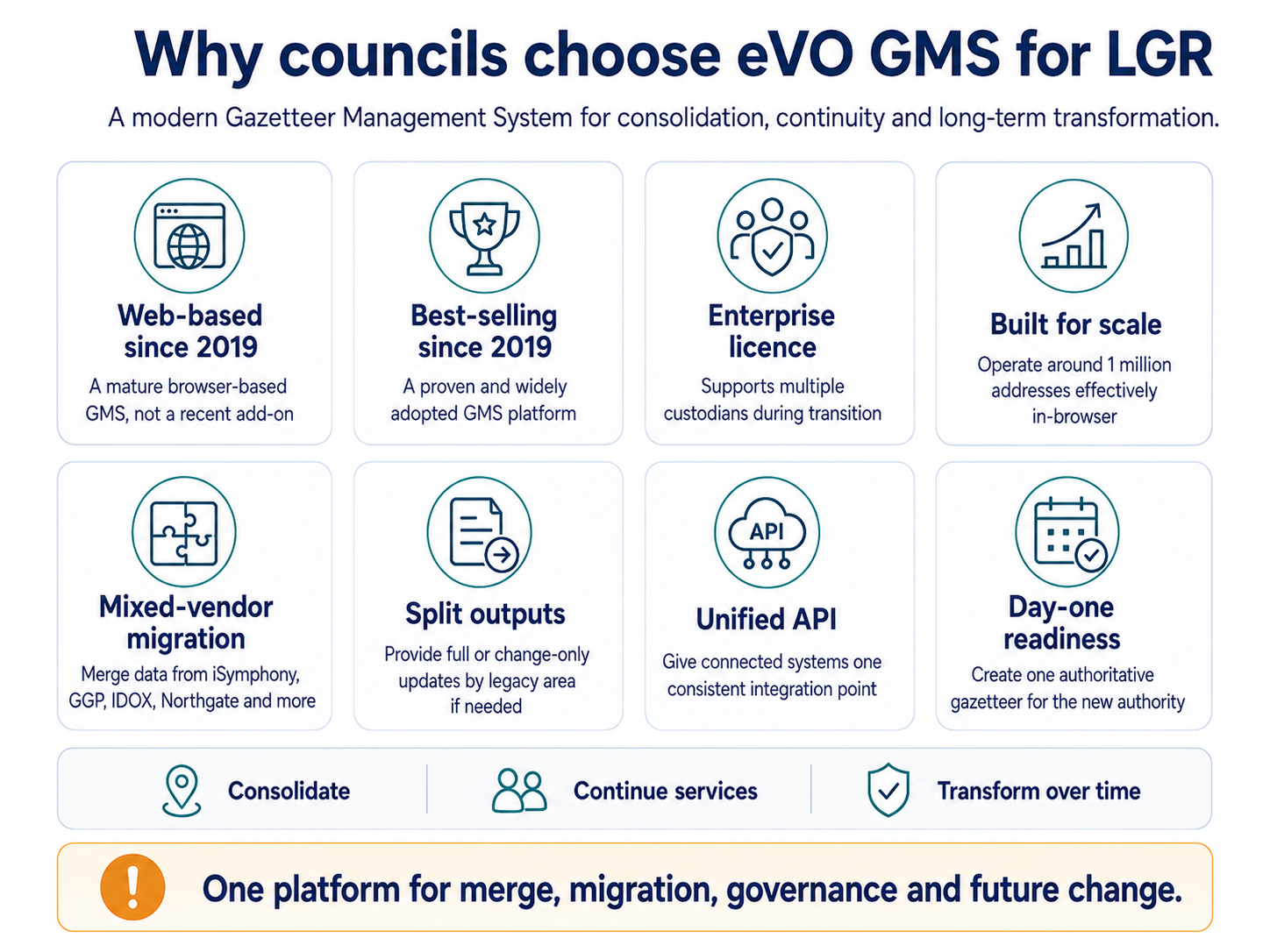
Why councils choose eVO GMS for Local Government Reorganisation.
The new authority starts with the gazetteer
Local Government Reorganisation is a rare opportunity to simplify, standardise and improve the data foundations of local public services.
But that opportunity can be lost if the gazetteer is treated as a back-office technical issue.
The LLPG and LSG are not just datasets for custodians. They are the trusted reference point for the new authority's services, systems, reporting and customer experience.
For LGR, the message is clear:
Unify the gazetteer from day one. Keep legacy systems running where needed. Replace them on your own timetable. Build the new authority on one source of truth.
StatMap can help councils plan, merge, validate and operate their gazetteer data before, during and after reorganisation.
Speak to StatMap about eVO GMS and LGR readiness
Talk to StatMap about how eVO GMS can support your Local Government Reorganisation programme.